
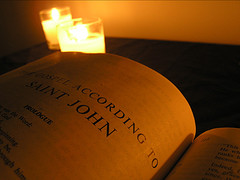
 The Fourth Gospel, traditionally referred to as the Gospel According to John, provides the closest example of explicit reference to authorship, though it too remains originally anonymous. Church tradition has long linked the Fourth Gospel with three early epistles and the Apocalypse, which bears the author’s name, John.[1] While debated (as all good scholarly truth claims are), there exists a good deal of evidence (vocabulary, structure, grammar, theology) indicating that the Fourth Gospel and the Apocalypse were written by the same individual.
As for which John this author was, one cannot be entirely sure, though given the wording used at the end of the Gospel (20. 30-31 and 21. 24-25), it seems that the accounts of the gospel were written by an eyewitness (the beloved disciple—possibly John—or John the Apostle) or, as some scholars have suggested, by the extant faith tradition of an eyewitness. Many scholars date the composition of the gospel to the late first century CE and the first extant manuscript fragment[2] has oft been dated to about 117-125 CE, meaning that even without an eyewitness account, the Fourth Gospel was written within two or three generations of the events described in the gospel. Very likely however, the gospel was written many years before the extant copy we have came into existence, meaning that it becomes highly likely that the Fourth gospel was composed by an eyewitness to the life, death, and resurrection of the Word, Jesus Christ.
[1] Apocalypse of St. John (Revelation) 1.1
[2] P52- the John Ryland’s Fragment of John 18


 Pursuing Veritas
Leave a reply to Vincent S Artale Jr Cancel reply